
This document provides a short introduction to the APIs available on the EnergyDataDK platform. If you’re new to the platform, we recommend starting with the Platform Guide and Data Owner Guide for a general overview of Energydata.dk and its features.
It is possible to import and export data via an API, the different mechanisms are the following:| Term | Meaning |
|---|---|
| API (Application Programming Interface) |
A set of rules that allows different software systems to communicate and exchange data with each other. |
| MQTT (Message Queuing Telemetry Transport) |
Lightweight messaging protocol used to transmit data between devices through a central server called a broker. It follows a publish/subscribe model: devices publish data to specific topics, and other devices subscribe to those topics to receive the messages. |
| MQTT Preffix | A single alphanumeric string configured by data owner. This prefix is placed at the beginning of all MQTT topics associated with specific data set. It acts as a simple identifier that groups topics together and distinguishes them from those of other data sets. |
| MQTT Sufix (Topic) | A unique label for a datastream. The suffix is added after the MQTT prefix and forms the full topic used when publishing or requesting data for that datastream. |
| Token | A token is a unique string used to authenticate and authorize access to an API or data service. It identifies the requester and ensures that only permitted systems or users can insert or retrieve data. |
| Deploy Token | A deploy token is a credential that is explicitly permitted to perform certain operations on specific datasets. It is intended for use when deploying devices or other systems in the field. Because a deploy token has only limited, predefined permissions, any compromise of the device or system using it results in minimal exposure. You can link any of the licenses you have via group memberships to the token. |
| Personal Access Token | A personal access token is a credential that carries the same rights as the user account that issued it. It is intended for use on the issuing user’s own computer for local development and testing.
Warning: If compromised, a personal access token can be used to access everything available to the issuing user. |
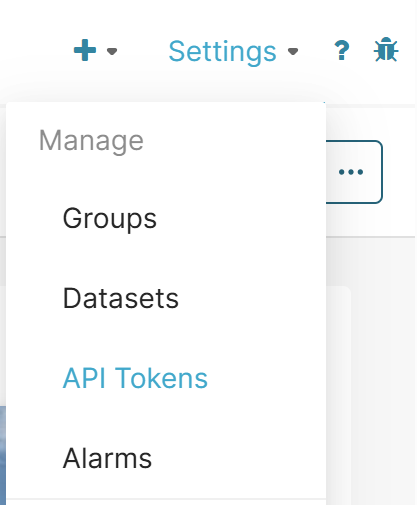
Which takes you to page shown below.
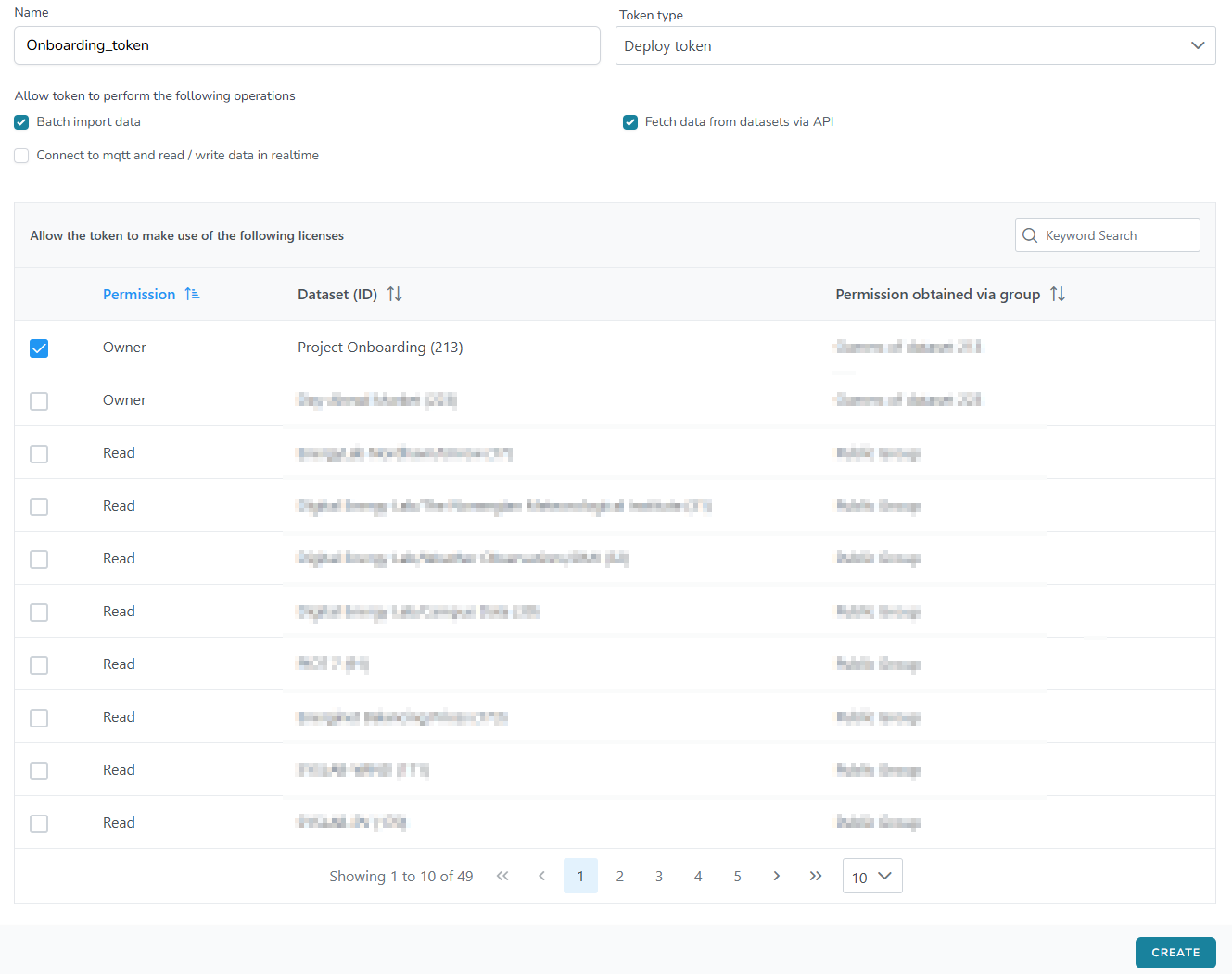

From this list, you can view token details or delete tokens, but the token value is not visible once created.
If you have historical data, you can upload them all at once using batch import API. You can upload one or more datastreams to a dataset you have “write” rights for, or that you are the owner of.
Before uploading the data, you must have a dataset created at energydata.dk that will receive the data. All the steps of dataset creation are explained in Dataset Creation section in Data Owner Guide.
It is also important to ensure that the CSV file used for batch upload is properly formatted. Incorrect formatting will result in the file being rejected.
The file must be formatted as CSV according to RFC4180. Additionally, if the file contains non-ascii characters, the file should be encoded as UTF-8.
The timestamps must be formatted as YYYY-MM-DD[T]HH:mm:ss.SSS[Z], e.g. 2021-05-01T10:12:44.432Z for May 1st 2023, 10:12:44.432 UTC. The timestamp must be in UTC timezone.
The type of the data in a column must match the datatype of the datastream to which the column belongs. If a datastream is an integer, any values for that datastream must be integers as well.
If a field is left empty, the handling depends on the datatype of the corresponding datastream. If the datastream is of type string, an empty string will be imported. If the datastream is of type integer or double, no value will be imported.
Below is an example file. Note that the first datastream (117217) is of type string, the second datastream (my/topic) is of type double and the last datastream (119221) is of type integer
;117217;my/topic;119221

2021-03-10T20:24:30.139Z;a_string;23.4121;-10

2021-03-10T20:24:31.144Z;"another string";999888777.121;0

2021-03-10T20:24:32.161Z;a third string;-1.33e-16;45

2021-03-10T20:24:33.186Z;;54.1;11

2021-03-10T20:24:34.201Z;a-fourth-string;;45
Note the empty fields in row 5 (datastream 117217) and row 6 (my/topic). For datastream 117217, an empty string will be imported with timestamp 2021-03-10T20:24:33.186Z. For datastream my/topic, no value will be imported with timestamp 2021-03-10T20:24:34.201Z.
EnergyDataDK’s API URL is: https://admin.energydata.dk/api/v1/import
You can do this from your personal computer’s terminal (command prompt), and the words inside “<>” are to be filled with your information.
Important: When filling in the information below, replace the entire placeholder including the < and > brackets.
Example:
ssh <username>@<ip_address>Your Input: ssh admin@123.45.67.89 (Not ssh <admin>@<123.45.67.89>)
curl -H "Authorization: Bearer <your_token>" -H "Accept: application/json" -X POST https://admin.energydata.dk/api/v1/import --data-urlencode "importname=<import_name>"
The system will return a series of information:
{
  "user_id":<your_user_id>,
  "status":"stored",
  "name":"import_name",
  "updated_at":"2025-09-17T08:15:43.000000Z",
  "created_at":"2025-09-17T08:15:43.000000Z",
  "id":29598
}
From here we will need the user_id to continue with the next step, getting the upload URL.
Using the id obtained from the upload created, again in the terminal, type the following:
curl -H "Authorization: Bearer <your_token>" -H "Accept: application/json" "https://admin.energydata.dk/api/v1/import/<id>/upload_url"
{
"upload_url":"https:\/\/s3.energydata.dk\/import\/inbox\/s123456\/a53f2b5d-0493-44ea-bed7-e48c26cf99ed.csv?X-Amz-Content-Sha256=UNSIGNED-PAYLOAD&X-Amz-Algorithm=AWS4-HMAC-SHA256&X-Amz-Credential=edk-s3-root%2F20250917%2Fdefault%2Fs3%2Faws4_request&X-Amz-Date=20250917T082537Z&X-Amz-SignedHeaders=host&X-Amz-Expires=7200&X-Amz-Signature=29744bc062fe06d545250c56b2cc8e19cdf4095b9fd936392fdb7f92ab88f1bc"
}
The “upload_url” is need for the following steps, however, it is returned with “\/” rather than only “/”, so these need to be substituted.
Using the modified “upload_url” from the previous step, type the following:
curl -H PUT -T "<path_to_file>" -H "Content-Type: application/octet-stream" "<upload_url>" The system does not return anything, but we still have to validate and ingest the upload.
To validate the import, the “id” is needed again:
curl -H "Authorization: Bearer <your_token>" -H "Accept: application/json" -X PUT https://admin.energydata.dk/api/v1/import/<id>/validate
{
  "id":29598,"name":"import_name",
  "status":"validating",
  "user_id":407,
  "datastreams":null,
  "validated_lines":0,
  "ingested_lines":0,
  "min_ts":null,
  "max_ts":null,
  "validated_at":null,
  "ingested_at":null,
  "created_at":"2025-09-17T08:46:40.000000Z",
  "updated_at":"2025-09-17T09:39:48.000000Z"
}
To check that we have followed all steps properly, the “status” should be “validating”.
The last step is ingesting the upload:
curl -H "Authorization: Bearer <your_token>" -H "Accept: application/json" -X PUT https://admin.energydata.dk/api/v1/import/<id>/ingest
{
  "id":29598,
  "name":"import_name",
  "status":"ingesting",
  "user_id":407,
  "datastreams":[1205191,1205192],
  "validated_lines":<number of lines>,
  "ingested_lines":0,
  "min_ts":"<your_min_ts>",
  "max_ts":"<your_max_ts>",
  "validated_at":"2025-09-17T09:39:55.000000Z",
  "ingested_at":null,"created_at":"2025-09-17T08:46:40.000000Z",
  "updated_at":"2025-09-17T10:59:05.000000Z"
}
What is important to check here is the “status”, it should be “ingesting”, otherwise this can mean that there is something wrong with your CSV file.
Here is an example code written in python to batch upload data. When downloading, it is necessary to change the file from .txt to .py, or simply copy and past to your preferred code editor. If you proceed with the latter, it must be divided into two files, with the same names as the downloaded files.
					import pytz
import csv
from datetime import datetime
from EnergyDataImport import EnergyDataImport


# ###### CONFIGURATION ######
CSV_FILE_PATH = r"<PATH_TO_YOUR_CSV_FILE>"
AUTH_TOKEN = "<YOUR_TOKEN>"
DATASTREAM_IDS = ["<YOUR_DATASTREAMS_IDS>"]  # Format: ["datastream_ID1", "datastream_ID2"...]
IMPORT_NAME = "default.csv"
# ###########################


# ----- NO NEED TO MODIFY ANYTHING AFTER THIS POINT -----

def run_multi_import():

    # 1. Pass the list of IDs to the properties argument

    with EnergyDataImport(

        upload_filename=IMPORT_NAME,

        properties=DATASTREAM_IDS,  # Class creates a header with all IDs

        energydata_api_token=AUTH_TOKEN,

        overwrite=True

    ) as batch:

        with open(CSV_FILE_PATH, mode='r', encoding='utf-8') as f:

            reader = csv.reader(f, delimiter=';')

            next(reader) # Skip metadata line

            for row in reader:

                if not row or len(row) < (len(DATASTREAM_IDS) + 1):

                    continue

                # Parse timestamp (Column 0)

                raw_ts = datetime.strptime(row[0], "%Y-%m-%dT%H:%M:%S.%fZ")

                utc_ts = pytz.utc.localize(raw_ts)

                # 2. Extract values for all streams (Columns 1, 2, and 3)

                # Ensure the list length matches len(DATASTREAM_IDS)

                values = [float(row[i+1]) for i in range(len(row)-1)]

                # 3. Add the row to the batch

                batch.add_values(utc_ts, values)

        # Proceed with the standard lifecycle

        batch.upload()

        batch.validate()

        batch.ingest()

if __name__ == "__main__":

    run_multi_import()
Auxiliary file – EnergyDataImport.py
This code is meant to contain the functions in the main one. Nothing needs to be modified.
					import requests
import csv
import time
import os
import pytz
import json
from datetime import datetime
from enum import Enum
from typing import List
from pathlib import Path

class EnergyDataImport:
    """
    A utility class to make batch importing to EnergyData.dk easier from Python.

    This class handles building a CSV file in the correct format to be used for
    importing to EnergyData.dk via the batch API. It manages the entire lifecycle:
    creating the proper CSV, uploading, validating, and ingesting the file.
    """

    # The API host for EnergyDataDK import endpoints
    API_HOST = 'https://admin.energydata.dk/api/v1/import'
    API_HEADERS = { 'Accept' : 'application/json' }

    # The format required by EnergyDataDK for timestamps
    TIMESTAMP_FORMAT = '%Y-%m-%dT%H:%M:%S.%fZ'

    class Status(Enum):
        """Internal state machine to track the progress of the import job."""
        UNINITIALIZED = 0
        OPEN = 1
        CLOSED = 2
        UPLOADING = 3
        STORED = 4
        VALIDATING = 5
        READY = 6
        INGESTING = 7
        DONE = 8
        ABORTED = 9
        ERROR = 10

    def __init__(
        self,
        upload_filename: str,
        properties: List,
        energydata_api_token: str,
        overwrite: bool = False,
        tmp_dir: str = '/tmp/energydata_batch_upload',
        autoclean_tmp_files: bool = True):
        """
        Constructor for class. Create an instance for each batch upload.
        An instance cannot be reused between multiple imports.

        Args:
            upload_filename (str): Name for the import file generated locally and used on the server.
            properties (List): List of property IDs or Topics to which data will be added.
            energydata_api_token (str): API token from https://portal.energydata.dk/user#accesstokens.
            overwrite (bool): Controls whether to overwrite existing local or remote files.
            tmp_dir (str): Directory for temporary CSV storage before upload.
            autoclean_tmp_files (bool): If True, removes local files once the context is closed.
        """
        self.status = self.Status.UNINITIALIZED
        self.import_id = None
        self.upload_url = None
        self.added_lines = 0
        self.previous_ts = None
        self.upload_filename = upload_filename
        self.local_file_path = Path.joinpath(Path(tmp_dir), Path(upload_filename))
        self.properties = properties
        self.energydata_api_token = energydata_api_token
        self.overwrite = overwrite
        self.tmp_dir = tmp_dir
        self.autoclean_tmp_files = autoclean_tmp_files
        self.api_headers = dict(self.API_HEADERS)
        self.api_headers.update({'Authorization': f'Bearer {energydata_api_token}'})

    def __enter__(self):
        """
        Prepares the environment: creates the temp directory and opens the CSV file for writing.
        """
        self.__assert_status(self.Status.UNINITIALIZED)
        Path(self.tmp_dir).mkdir(parents=True, exist_ok=True)

        if not self.overwrite and Path.exists(self.local_file_path):
            raise Exception(f"File '{self.upload_filename}' already exists. Set overwrite=True.")

        self.fd = open(self.local_file_path, mode='w', newline='')
        # CSV format: delimiter ';', double quotes for strings, non-numeric quoting
        self.writer = csv.writer(self.fd, quoting=csv.QUOTE_NONNUMERIC, delimiter=';',
                                quotechar='"', escapechar='\\', doublequote=False)
        # Header row: First column is empty (reserved for timestamp), followed by property list
        self.writer.writerow([''] + self.properties)

        self.__change_status(self.Status.UNINITIALIZED, self.Status.OPEN)
        return self

    def __exit__(self, type, value, traceback):
        """Closes the file descriptor and handles automatic cleanup of local files."""
        if hasattr(self, 'fd') and not self.fd.closed: self.fd.close()
        if self.autoclean_tmp_files and os.path.exists(self.local_file_path):
            os.remove(self.local_file_path)
        self.status = self.Status.CLOSED

    def add_values(self, time: datetime, values: List):
        """
        Adds a row of data to the import buffer.

        Args:
            time (datetime): Timestamp. Must be timezone-aware.
            values (List): Data values matching the number of properties in the constructor.

        Raises:
            Exception: If time is not timezone-aware or if timestamps are not monotonically increasing.
        """
        self.__assert_status(self.Status.OPEN)
        if time.tzinfo == None:
            raise Exception("No timezone specified for the datetime object.")
        if len(values) != len(self.properties):
            raise Exception(f"Expected {len(self.properties)} values, found {len(values)}.")
        if self.previous_ts is not None and time <= self.previous_ts:
            raise Exception("Added timestamps must be strictly increasing.")

        self.previous_ts = time
        # Convert to UTC ISO format before writing
        self.writer.writerow(
            [time.astimezone(pytz.UTC).strftime(self.TIMESTAMP_FORMAT)] + list(values)
        )
        self.added_lines += 1

    def upload(self, print_progress = True):
        """
        Finalizes the CSV and uploads it to the server storage. Once called, state
        transitions from OPEN to UPLOADING and finally to STORED.
        """
        self.__change_status(self.Status.OPEN, self.Status.UPLOADING)
        self.fd.close()

        # 1. Create the import job record
        res = requests.post(url=self.API_HOST, headers=self.api_headers, params={'importname': self.upload_filename})
        res.raise_for_status()
        self.import_id = res.json()['id']

        # 2. Get the secure S3 upload URL
        res = requests.get(url=f'{self.API_HOST}/{self.import_id}/upload_url', headers=self.api_headers)
        res.raise_for_status()
        self.upload_url = res.json()['upload_url'].replace("\\", "")

        if print_progress: print(f'Starting file upload for job id: {self.import_id}')

        # 3. Upload the binary data
        with open(self.local_file_path, 'rb') as f:
            res = requests.put(self.upload_url, data=f, headers={"Content-Type": "application/octet-stream"})
        res.raise_for_status()

        self.__change_status(self.Status.UPLOADING, self.Status.STORED)
        if print_progress: print(f'Successfully stored job id {self.import_id}')

    def validate(self, errors_limit = 0, block = True, print_progress = True):
        """
        Triggers server-side validation. State transitions from STORED to VALIDATING
        and finally to READY.
        """
        self.__change_status(self.Status.STORED, self.Status.VALIDATING)
        self.__api_put_request(block, 'validate', lambda s: self.__validation_progress(s, print_progress), {'errors_limit': errors_limit})

    def ingest(self, block = True, print_progress = True):
        """
        Triggers final ingestion. State transitions from READY to INGESTING
        and finally to DONE.
        """
        self.__change_status(self.Status.READY, self.Status.INGESTING)
        self.__api_put_request(block, 'ingest', lambda s: self.__ingestion_progress(s, print_progress))

    def __api_put_request(self, block, path, progress_callback, body = None):
        """Helper to send PUT requests and poll for status updates."""
        res = requests.put(url=f'{self.API_HOST}/{self.import_id}/{path}', headers=self.api_headers, json=body)
        res.raise_for_status()
        while block:
            time.sleep(5)
            status = self.__get_status()
            if not progress_callback(status): break

    def __get_status(self):
        """Retrieves the current job metadata from the server."""
        res = requests.get(url=f'{self.API_HOST}/{self.import_id}', headers=self.api_headers)
        res.raise_for_status()
        return res.json()

    def __assert_status(self, expected):
        if expected != self.status:
            raise Exception(f"Expected status '{expected}', but found '{self.status}'")

    def __change_status(self, expected, to):
        self.__assert_status(expected)
        self.status = to

    def __validation_progress(self, status, print_progress):
        if print_progress: print(f'Validated {status["validated_lines"]}/{self.added_lines} lines')
        if status['status'] == 'validating': return True
        if status['status'] == 'ready':
            self.__change_status(self.Status.VALIDATING, self.Status.READY)
            return False
        raise Exception(f'Validation failed: {status["status"]}')

    def __ingestion_progress(self, status, print_progress):
        if print_progress: print(f'Ingested {status["ingested_lines"]}/{self.added_lines} lines')
        if status['status'] == 'ingesting': return True
        if status['status'] == 'done':
            self.__change_status(self.Status.INGESTING, self.Status.DONE)
            print("******Data uploaded successfully******")
            return False
        raise Exception(f'Ingestion failed: {status["status"]}')
After the you have input your data, and ran the main file, batch_upload.py, several prints will be shown in the terminal, including the number of lines uploaded, and when the data has been uploaded successfully.
Please note that for large datasets, the ingestion process can a few minutes.
You can use the fetch data API to download data from one or more datastreams from a dataset. Please note that you need “read” rights to fetch the data. The resource can be used to retrieve either the latest values, or values which correspond to a timespan.
Please note that this resource does not return JSON for successful requests. In these cases, response data is streamed back to the client as CSV. But you should still specify Accept: application/json in the header to ensure errors are returned to the client as JSON.
To fetch data, you have to use the following URL: https://admin.energydata.dk/api/v1/datastreams/values, with some API parameters, which are:
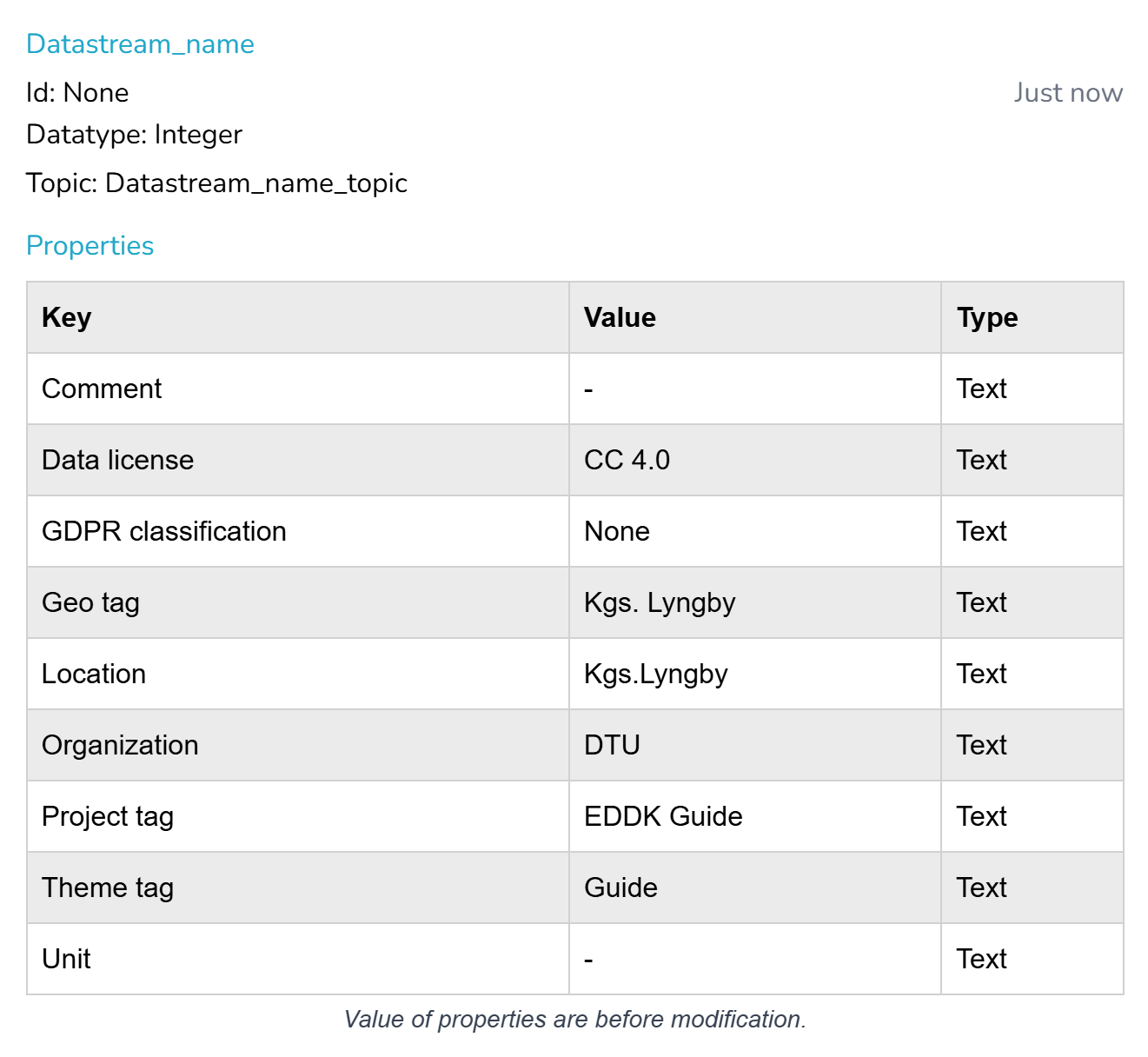
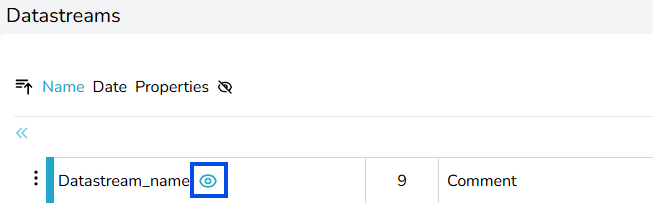
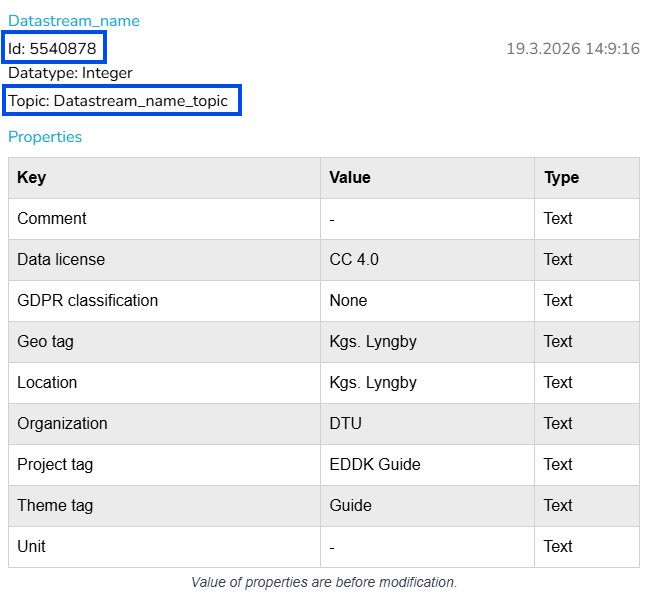
To obtain the datastream ids, if you are the owner, you can see these at the respective dataset page, clicking in the datastream you are interested in (reference same picture as in the bath upload). If you only have “Write” rights, you can only see these by yourself by downloading from the website a fraction of the data, even if it is empty. From such file, the headers contain the desired ids and topics.
To retrieve values for a specific time range, limited by the “from” and “to” indicators. You can do so by typing the following in the terminal command prompt in your personal computer. Please note that vales within “<>” refer to those you have to fill with the information you want to retrieve, including the output file.
Important: When filling in the information below, replace the entire placeholder including the < and > brackets.
Example:
ssh <username>@<ip_address>Your Input: ssh admin@123.45.67.89 (Not ssh <admin>@<123.45.67.89>)
curl -X GET "https://admin.energydata.dk/api/v1/datastreams/values?ids=<list_of_datastreams>&from=<start_of_timespan>&to=<end_of_timespan>" -H "Accept: application/json" -H "Authorization: Bearer <your_token>" -o "<output_file.csv>"
% Total    % Received % Xferd  Average Speed   Time    Time     Time  Current

Dload  Upload   Total   Spent    Left  Speed

100    46    0    46    0     0    271      0 --:--:-- --:--:-- --:--:--   277
This method returns the latest row (or timestamp) of the available data for the specified datastream or datastreams. No need to specify “from” or “to”, only the datastream ids.
curl -X GET "https://admin.energydata.dk/api/v1/datastreams/values?ids=<list_of_datastreams>&latest=True" -H "Accept: application/json" -H "Authorization: Bearer <your_token>" -o "<output_file.csv>"
The output will look something similar to this, but with the specific data from your import. The output csv file will be stored in the directory in which you are working at.
% Total    % Received % Xferd  Average Speed   Time    Time     Time  Current

Dload  Upload   Total   Spent    Left  Speed

100    32    0    32    0     0    218      0 --:--:-- --:--:-- --:--:--   225
The MQTT API allows you to upload (publish) data to one or more datastreams or download (subscribe to) one or more datastreams in real time. Multiple values can be published simultaneously, and MQTT’s Quality of Service (QoS) is supported. To use the MQTT API, you must have “write” rights to the dataset or be its owner.
The API is built on top of the MQTT protocol, version 3.1.1. The broker is available at mqtts.energydata.dk and is open for MQTT connections on port 8883.
Publishing data allows data providers to send data to be stored in EnergyDataDK. It is possible to publish single value and multi value messages.
Single value messages contain a timestamp and a value. The datastream associated with the message is inferred from the MQTT topic. The timestamp must be an integer in Unix Epoch format, that is, the number of milliseconds since 01-01-1970. The value type depends on what is specified on that specific datastream, string, double or integer. An example:
{
  "timestamp": 1521797973469,
  "value": 14.47
} {
"timestamp": 1521797973469,
"value": {
"my/topic/suffix1": 14.47,
"my/topic/suffix2": 34,
"my/topic/suffix3": 4.87,
"my/topic/suffix4": 1,
…. ,
"my/topic/suffixn": 300
}
}
					import paho.mqtt.client as mqtt
import time
import json

# MQTT Configuration
broker_host = 'mqtts.energydata.dk'
broker_port = 8883
publish_topic = "<your_dataset_mqtt_prefix"
token = "<your_token>"

client = mqtt.Client()
client.username_pw_set(token)
client.tls_set()

# Connect to the broker
print(f"Connecting to {broker_host}...")
client.connect(broker_host, broker_port, 60)

# Start the network loop in a non-blocking way
client.loop_start()

# Publish a message every second
try:
    for i in range(1000):
        timestamp = int(time.time() * 1000)
        message = json.dumps({
            'timestamp': timestamp,
            'value': {
                "<your_datastream_topic>": <your_values>,
                "<your_datastream_topic>": <your_values>}
                })
        # Publish with QoS1 and wait for acknowledgement
        message_info = client.publish(publish_topic, message, qos=1)
        message_info.wait_for_publish(timeout=10)
        print(f"Published: {message}")
        time.sleep(1)  # Wait 1 second for it to publish
except KeyboardInterrupt:
    print("Stopping publisher...")
finally:
    client.loop_stop()
    client.disconnect()
    print("Disconnected.")
When publishing to EnergyDataDK using MQTT you should use Quality of Service (QoS) 1 to ensure that messages are delivered. This is especially important if you publish with a high throughput, as overload protection mechanisms can discard your messages. Why and how is described in detail below.
When the EnergydataDK MQTT broker receives a publish message from your client, the message is added to a queue of incoming messages. This queue is per-client, and can contain up to 1000 messages. Messages in the queue are dequeued serially in a FIFO manner. When dequeued, the MQTT broker checks that the client is authorized for publishing messages on the given topic.
If authorization succeeds, the message is forwarded for storage in EnergyDataDK, and to any clients subscribed to the given topic. If the message was published with QoS 1 or 2, the MQTT broker sends the acknowledgement after authorization succeeds.
If authorization does not succeed, the client is immediately disconnected and any messages in the incoming message queue are discarded.
If the MQTT broker is not able to keep up with the client, the incoming message queue will eventually be full. When the queue is full, the MQTT broker discards any messages it receives from the client.
This means your client must throttle itself to avoid losing messages. You do this by publishing your messages with QoS 1. Your client must then wait to receive an acknowledgement from the broker before publishing more messages. This can be done in Python with the paho-mqtt <https://pypi.python.org/pypi/pahomqtt/>_ library with the function wait_for_publish.
It allows subscribers to receive real-time messages with the data published to EnergyDataDK. An example Python code on how to subscribe to a specific datastream to retrieve its live data is shown below, where again where the words inside “<>” are to be filled with your information. You might have to pip install paho-mqtt.
					import paho.mqtt.client as mqtt
from datetime import datetime, timezone

# MQTT Configuration
broker_host = 'mqtts.energydata.dk'
broker_port = 8883
subscribe_topic = "<mqtt_prefix/datastream_topic>"
token = "<your_token>"

# Callback when the client connects to the broker
def on_connect(client, userdata, flags, rc):
    if rc == 0:
        print(f"Connected to {broker_host} successfully!")
        client.subscribe(subscribe_topic, qos=1)
        print(f"Subscribed to topic: {subscribe_topic}")
    else:
        print(f"Connection failed with code {rc}")

# Callback when a message is received
def on_message(client, userdata, msg):
    payload = msg.payload.decode()
    print(f"[{datetime.now(timezone.utc)}] Received `{payload}` from `{msg.topic}`")

# Create and configure the MQTT client
client = mqtt.Client()
client.username_pw_set(token)
client.tls_set()
client.on_connect = on_connect
client.on_message = on_message
The MQTT_prefix is the one corresponding to the dataset, why the datastream topic is for the specific datastream.
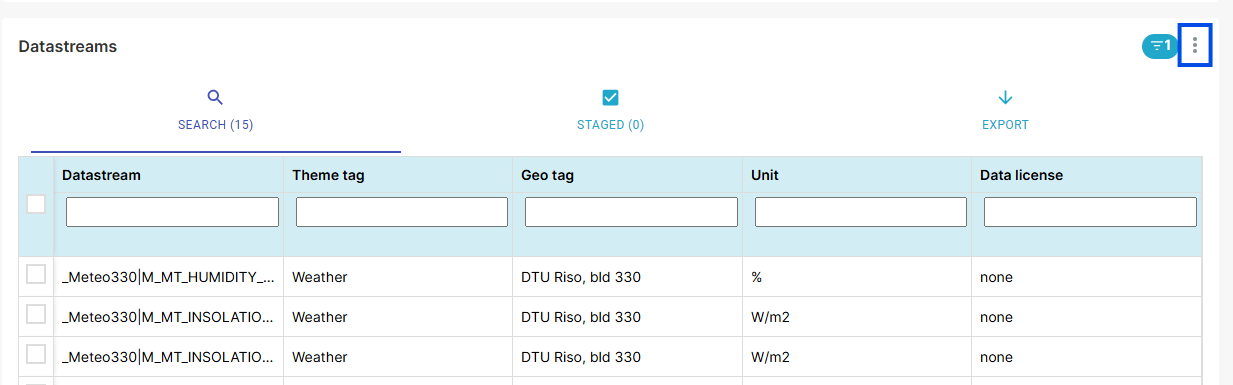
Another option is to download the complete metadata for the selected dataset by clicking the download icon located in the top-right corner of the Datastream page (Fig. 5). This download includes metadata for all datastreams, along with their corresponding names and IDs.